Bet-Hedging example for the Course Evolutionary Biology 2025/2026
evobio
Published
April 5, 2026
Idea
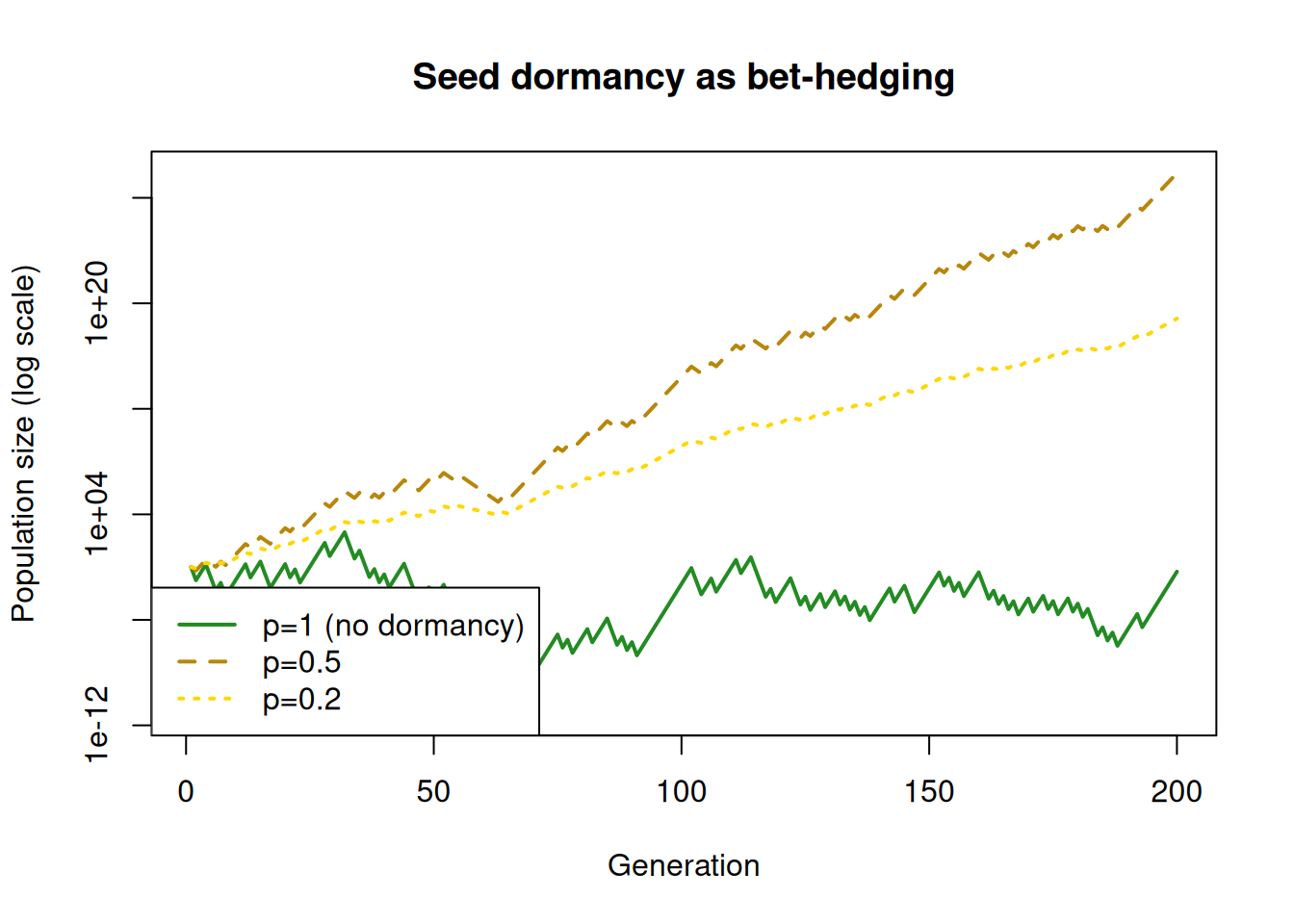
Bet-hedging is often the best an organism can do to face environmental uncertainty when learning/plasticity is not an option. Here we explore a simple model of bet-hedging (for more see https://github.com/tecoevo/informativecues) as a baseline for the evolution of plasticity. In this “desert”, where it rains with probability 6 years out of 10, plants can either germinate or remain dormant. The lineages that minimize the variance the most (0.5 probability of germinating) have the highest long-term fitness.
Simulation
set.seed(2)T <-200# Probability of good rain yearq <-0.6env <-rbinom(T, 1, prob = q)# Strategies: fraction germinatingp_values <-c(1, 0.5, 0.2)results <-list()for (p in p_values) { N <-numeric(T) N[1] <-1for (t in2:T) {if (env[t] ==1) {# good year: germinated seeds reproduce W <- p *4+ (1- p) *1# dormant survive } else {# bad year: germinated suffer W <- p *0.1+ (1- p) *1 } N[t] <- N[t-1] * W } results[[as.character(p)]] <- N}# Plotplot(results[[1]], type ="l", log ="y", lwd =2,xlab ="Generation", ylab ="Population size (log scale)",main ="Seed dormancy as bet-hedging",ylim=c(min(results[[1]]),max(unlist(results))+50),cex=2,col=c("forestgreen"))lines(results[["0.5"]], lwd =2, lty =2,col="darkgoldenrod")lines(results[["0.2"]], lwd =2, lty =3,col="gold1")legend("bottomleft",legend =c("p=1 (no dormancy)", "p=0.5", "p=0.2"),lty =1:3, lwd =2,col=c("forestgreen","darkgoldenrod","gold1"))